16/04/20
So today the government announced the lockdown has been extended. Boris Johnson is still recuperating at Chequers after he fell ill with COVID-19 and ended up in Intensive Care. The unknown is still a major worry. I’m coming to the end of my undergraduate degree and I feel somewhat let down by the government. No mention has been made of us students, especially final years, and what will happen. We are expected to carry on and adjust. Sometimes that can’t happen and I feel for the people struggling. University is mentally and physically draining on any normal day, let alone when you’re cooped up indoors with a family that don’t particularly understand the need for study – or maybe that’s just my situation? Anyway, we officially have ‘at least’ 3 more weeks of this – see what I mean by the unknown, I wouldn’t say the term ‘at least’ is encouraging. I’m writing this on a Thursday, which has become the day for NHS workers, every week at 8pm we stand on our doorsteps and clap for our heroes. Part of me thinks they deserve much more i.e a government which will actually fund them properly. What’s a clap going to achieve in a time of crisis? Anyhow spirits seem to be up, people are coming together in a way that I would expect we would in a time of major conflict. I’ve kept the letter we got sent from 10 Downing Street and I’ve bought a newspaper to show my kids one day. I study history for a reason. I never thought I’d be living through a major event in it.
Archives
All posts by Dr Kristopher Lovell

The Astronomical Clock in Prague
One of the first fictional pieces I wrote. It is very rough, but it is based on my awkward and uneasy obsession with the novels of Milan Kundera and my visit to Prague last year.
Under the shadow of the Old Town Hall, between Charles Bridge and Wenceslas Square, I sat quietly recording notes for a few stories in between some people-watching. As always, a large crowd had gathered underneath the Astronomical Clock just before the hour to watch the ancient puppet show and as always I am fascinated by the crowd’s reaction which shifts from anticipation, excitement to disappointment. Watching the crowd, I notice Milan on the other side. He’s also ignoring the medieval animated figures in favour of the tourists. They are gazing at God’s windows, we think.
His gaze, however, is fixated on a young woman in particular whose hands are gesticulating wildly as she explains the history of the clock to her friends. With a semiotician’s fascination, his steely blue eyes trace the motions of her hands. I wonder if her movements have inspired a new work of literature. Perhaps she is the new Agnes from Immortality? His stare quickly moves beyond an innocent look of intellectual curiosity towards something more lascivious and disconcerting. By observing his observations so intently, the subtext has ceased to be subtext, the intellectual veneer removed.
As the crowd armed with a multitude of cameras and phones disperses, so does he. He seems to move uncomfortably across the Old Town Square even though there is a quiet confidence in his strides, his self-assured steps. After a few metres, I wonder if that discomfort comes not from him but the background. It’s not that he doesn’t fit in: the world doesn’t fit him anymore. Milan is a true exile, not just from this country, but from time.
He is a native Czech, born 90 years ago just two hours from Prague, but the country he was born into no longer exists. He was born three countries ago. Now it is the Czech Republic but before that, the Czechoslovak Socialist Republic, the Protectorate of Bohemia and Moravia, and, when he was born, democratic Czechoslovakia; it has been occupied, liberated, reoccupied, and re-liberated several times since he was born and yet he has remained steadfast, immortalised in his works. For better or worse? I think.
Adorned with a large felt hat, he has a distinctly Parisian sartorial style, one that has been adopted subconsciously after decades of sitting in bars and cafes overlooking the Seine. His outfit covers the majority of his face in shadow, reinforced by the turned-up collars of a man who conspicuously does not want to be seen. As a seasoned people watcher, he spots a fellow acolyte in me and saying nothing sits in the chair on the table next to me, forcing my gaze elsewhere out of propriety. A small glass of red wine arrives before him, ostentatiously standing out among the lakes of pilsner at every other table including my own. Where we look for romance and exoticness in Prague, he seeks the consolation of a new home. “A person who longs to leave the place where he lives is an unhappy person”, he once wrote. What, then, of the man forced to leave a country that no longer exists? A man who lives in a time long past?
As we sit there I can feel myself being watched in the periphery of his vision, and he can feel himself out of the corner of my eye. We watch without watching. The glass of wine reaches his lips, he sips and places it back down next to his hat. ‘Remember, Marcel Proust wrote: “Every reader, as he reads, is actually the reader of himself”, Milan says. “The writer’s work is only a kind of optical instrument he provides the reader so he can discern what he might never have seen in himself without this book. The reader’s recognition in himself of what the book says is the proof of the book’s truth.”‘
I don’t know if he’s talking to me or if he’s talking to myself. I’m the narrator of the great narrator’s story and yet even in this fantasy of my creation, I cannot imagine a dialogue, a conversation between pupil and master. We are, all of us, narrators and our stories are our own even when they are about other people.
Milan responds to my thought, talking softly into the rim of his glass: ‘The novelist is the sole master of his work; he is his work’.
I observe the discomfort of the world around him and quietly I come to accept that we all come to exists in times that are not our own. Our value as artists remain even if the worlds we depict change, and if those new worlds challenge our ideas. One day all of us will sit uncomfortably between the old and the new. We all need our Knight of the Mirrors, showing us our flaws and sometimes we are shown those flaws in what we read: sometimes in what we write.
12th March 2020
Today is the day the British may have to start taking Covid-19 seriously. This is the day of cancellation – the Australian GP, the Champions League, probably Euro 2020. The Prime Minister stoked the fires, telling the country they will “lose loved ones before their time.” Ten people have died, and the young and famous have begun reporting infections. I do not believe it will be long until lockdown – closures of schools cannot be far away. Non-essential work activity will not be far behind. I am selfishly hoping that restaurants and pubs will be closed before Mother’s Day comes around.
14th March 2020
Incredible anxiety over coronavirus, working in a precarious industry. Steve is already cutting shifts as cancellations come in their tens. What am I to do when we can’t afford the bills, if Kate and I both get ill and our money dries up? Will our landlord put our rent on hold for a couple of months? Lord knows. Will the grandparents make it through? Will it come around again next year?
—
Why is it so much easier to imagine the end of the world than the end of capitalism? Why are the majority of people determined to kill off vast amounts of people to stop the economy losing some points? Britain is now the only country in Europe not in full Covid lockdown because we have a bumbling idiot with a wallet stuffed by capital in charge, shoving his head deep into the sand.
15th March 2020
Beginning to feel rightly or wrongly paranoid about Covid. Thought I had flu-like symptoms earlier at work-now they seem to have passed.
16th March 2020
My livelihood becomes more and more insecure as the hours go by. At about 5.10pm the Prime Minister told the over-70s to remain indoors, and the population as a whole to avoid restaurants, pubs, and other meeting places. The cancellations have been rolling in. We saw twenty customers all day.
20th March 2020
Woke up early this morning. I don’t know what time it was but the light was coming through the curtains. I lay for a while, wondering what was different. I heard a robin outside the window chattering loudly – the only sound to be heard in a still morning. Then it occured to me: in all the time I had lain there I had not heard a single car. All of the closures: schools, workplaces, etc. meant that the silence of the morning was not punctured by the blaring of engines and the shaking of the walls. I wonder if it was that unprecedented silence that woke me, the absence of the rumble of normality.
—
Maybe this crisis will buy us some time with climate change, as industries the world over shut down indefinitely, people remain in their homes, and cars remain on driveways. A little reprieve for the atmosphere.
—
News came in whilst I was at work this evening that pubs and restaurants are to shit their doors tonight for the foreseeable. Meanwhile the government have set up a fund to pay suddenly unemployed staff. Suddenly I have found myself on a 12 week (at least) paid holiday.
24th March 2020
We are only allowed outside once a day for exercise. Hard to enforce but surely a good way to minimise infection. For this reason I am about to take to the exercise bike for the first time in weeks.
25th March 2020
The lockdown makes it unlikely I will fulfil my goal of walking 1500 miles this year, confined to one trip out per day as we are, for no longer than is necessary. I did 8 miles on the bike (indoors) today to make up for it.
—
Perhaps spent too long with the grandparents today, though they insisted we had a socially distanced cup of coffee in the garden we should perhaps have told them no. It would have been hard though, they must be terribly frustrated stuck in the house as they are.
26th March 2020
Keeping this journal is the only way I can keep up with the date during this confinement. Not that the date, or the day of the week, is in any way important, the arbitrary nature of the calendar become clearer and clearer as time marches on the same every day. Without the tiresome obligation to work for my living, the day and the hour have proven their irrelevance, simply a means of dominating our minds, imprisoning us in the structures of work.
28th March 2020
The strangeness and discomfort of social isolation began to set in this afternoon, I think in part because the sun went away: there is no longer a friendly reminder of the springtime lightening our rooms, and leaving its warmth behind in the evenings.
I desperately miss being able to walk out where I please, seeing other people face to face, and popping into the shops when I want to. I have not yet got so desperate as to miss work. On that note, I received my notice of furlough this morning, confirming that I will continue to be paid throughout this process, and will hopefully have a job to go back to when we can resume living normally (whatever normality looks like at the end of this.) There is a little less to be concerned about. Now I just need to wait for a moratorium on rent(!)
30th March 2020
Went twice to the grandparents’ to deliver supplies, simply for a drive out and something to do. This evening kate convinced me to play and enjoy Minecraft.
31st March 2020
The sun has come out again today, bringing a brighter aspect to quarantine proceedings. Got out to walk my three miles this morning and got a little sweaty in the process – the sun is quite warm and the wind still icy. Currently just cooking some sausages for lunch – we’re out of bread so it will be a lunchtime wrap with fried egg, tomato and mushrooms.
1st April 2020
This quarantine has got me thinking about Homogeneous, Empty Time. People who wouldn’t previously have stopped to think about it are realising that the time of capitalism is devoid of meaning, now that they have to fill the whole 24 hours of their own accord, prevented from the usual busywork necessitated by capital, prevented from social gatherings, left to consider absolute naked alienation in the isolated modern mode of existence. This crisis has proven the unsuitability of modern communications technology to actually provide the means to have fulfilling social encounters. It is better than nothing to be able to hear friends down the fibre-optics, but the silence of VOIP servers is deep and uncomfortable, and conversations between people planted in front of the whole distraction of the internet are often frustrated.
2nd April 2020
Slightly embarrassing that the people of Britain take to the streets every Thursday at 8pm to applaud. Highly dystopian behaviour.
3rd April 2020
Back from my morning walk, I have decided that today is the first since last Autumn that it is appropriate to open the sash window in the living room and let some of the fresh Spring air into our perennially dark front spaces. Down by the river the Friar’s playing fields are being mown, unleashing a heady scent that mingles with the late-blooming hyacinths. I saw a collection of long-tail tits in the trees on the banks and innumerable bees of all shapes and stripes. I wonder if wildlife is more abundant than usual due to reduced footfall around the town. Dad has seen bullfinches and reed buntings at Stern’s, but that’s not as unusual in such a secluded space.
4th April 2020
I am a little sick of isolation now; it would be nice to go out and do things, not be stuck in the house and its immediate surroundings the whole time. I went out to take pictures this afternoon. I wanted birds but hadn’t the patience to wait for them, so I got bees and flowers instead. What will I do tomorrow? Probably something very similar to today.
6th April 2020
If there is one thing I appreciate about this period of quarantine it is having my evenings again, time to spend intimately with Kate, time that is hard to come by when work is in full fow. Tonight was pleasant: we had rum and coke with curry for dinner, played backgammon, which I repeatedly lost at (it is a silly game). We talked about animals and had tea and cake for our pudding and watched videos about films. Idyllic. I can head to bed this evening, washed and stretched, feeling like I have had a fulfilling day, no longer worrying about whether I have spent my time wisely, now that time is no longer a commodity to be consumed but a long and languid space to be filled with anything that takes my fancy (so long as it conforms to social distancing.) It is easier to get up early too, having the luxury of unlimited hours ahead of me, and nowhere to be but inside the house.
7th April 2020
Today’s highlight: receiving my crate of Hobson’s I shall be in beer or the forseeable.
8th April 2020
I have spent the morning reading, nearly reaching the end of the King’s General, some poetry, a bit of Marx. Haven’t ventured outside yet today and it is after lunchtime. I ought to go out for a walk but I can’t face it. Breaking my routine by failing to undertake necessary exercise – embracing self-abandonment like the protagonist of a bourgeois novel, though perhaps with less drama due to circumstances and my own temperament.
9th April 2020
Having another difficult day with my mental health, have barely been outside though the weather remains beautiful. Again I couldn’t face it. Could barely do anything beyond merely floating about the house listless, thinking of activities and dismissing them immediately out of hand. Having nothing to look forward to is my usual problem, could be the same thing now – just weeks of seclusion stretching out before me. Tomorrow will mark three weeks since my furlough. I must get back to my exercise routine, I will be losing my progress.
12th April 2020
We had three drops of rain (approximately) this lunchtime. It has been a while since we had a decent downpour, the river is beginning to look a little low and the soil is getting cracked and dusty. With no change in the forecast for the foreseeable it is conceivable that we go from record breaking floods to a drought in no time at all. Such is modern life in a collapsing climate. The crises keep stacking up, and nature is reminding us that covid has not made the danger of climate change any less immediate. It is inconceivable that life returns to normal again.
—
In brighter news, the first bluebell blooms have appeared in my garden; they weren’t there last year, but have been freed and encouraged by my hard work to keep back the weeds and create space for the dormant seeds to grow. It is gratifying that nature can still reward a little conscientious effort.
15th April 2020
Isolation is still playing havoc with my mental states. Had a stress dream last night: A-Level Maths again, third night in a row, followed by some more general school content. Woke up in full lizard brain fight-or-flight mode. Jumped out of bed and ran downstairs panting. It has persisted all day: even now I am filled with a generalised anxiety, like there is something I should be worried about, something very important just on the edge of recollection and if only I could just reach out I might be able to remember it. It is nothing though, probably just panic over food shopping, which has taken on a whole new aspect under social distancing. Still just a slightly greater inconvenience than before, with the queues and the distancing manoeuvres in the aisles, but my brain has worked it up to something greater.
A Creative Nonfiction essay I started to write after being shortlisted for bone marrow donation. This piece is a personal essay, but one that also draws on the techniques used in experimental journalism especially New Journalism. This piece was intended to be part of a serialised account detailing the whole process, highlighting the importance of donation whilst also exploring my own anxieties. The project was abandoned after I didn’t make it to the final (someone else was a better match) but thought I would share the initial idea.
19 September 2019
The sun unapologetically glares through the curtains. It’s mid-morning and I’ve already got a small collection of e-mails I need to catch up on. A dreaded task that requires dark brown coffee. I am behind before I have started. One email stands out from the crowded inbox:
Subject: DKMS UK Health Questionnaire
Potential Stem Cell Donation
Excited at the prospect of being a donor, I can feel my heart beat faster; trepidation rising within me. I happily signed up to be a donor as part of Paddy’s Plea, a campaign to find a donor for a local boy who needed to find a match. I have proudly donated blood for several years and I believe in donating all of my organs – but once I’ve finished with them. Bone marrow donation worries me a little, but I signed up knowing that I’d never be picked. After all, 70% of patients don’t match with their own family members let alone a stranger, so the chances of my human leukocyte antigen (HLA) matching anyone else’s was minimal right? Apparently not.
The science behind it or how it is done did not worry me – it was everyone’s reaction when I told them.
My office mate, who had been tested at the same time as me, told me outright: ‘I’m so glad it was you who was a match and not me.’
‘Bone marrow?! That’ll be agonising’, said another colleague.
‘I wouldn’t donate mine. Too painful.’
An older colleague visibly grimaces: ‘You’re braver than me.’
Let’s get one thing straight early on: I am not brave. Not in the slightest. The bravest thing I’ve ever done is unplug my phone charger without turning it off at the wall. And although I know the procedure is painful, it is the fear of pain that is often much worse than the pain itself. And I fear a lot of pain. When I donate blood I have to watch the nurse put the needle in so I know exactly when the jab is coming. If I cannot see it, I feel myself going hysterical at the prospect that this time the pain will be excruciating.
Reading the e-mail, the consent forms, the health questionnaire, my anxiety skipped a few gears. I have a few fears in life, all of which feel particularly related to the anticipation I am feeling even though some of them are at odds with each other.
Death. I fear death all the time. I’m constantly thinking about death from the moment I wake up to the moment I fall asleep, fearing that I might not wake up. My happiest dreams are Kafka’s nightmares. I fear when it will come, how it will get me and at whose hands. I don’t fear it enough to live a healthy life though. I could probably cut down 90% of my weekly alcohol intake and still comfortably be defined as a binge drinker. I’ll happily eat pizza or biscuits for breakfast (you’d eat both – don’t lie to yourself, Kristopher). But the fear does stop me from living life, from strenuous activities like walking through a forest that is full of nature’s death traps or exercising beyond a jaunty jog down the stairs for more coffee and biscuits (I have this fear that it has been so long since I’ve exercised that if I start now it will just shock my heart so it’s best to stay the course).
Pain. I’m a historian. Arguably it is not a high-risk occupation. Sometimes I get a nasty paper cut which I forget about until I eat some salt and vinegar flavoured crisps. I might forget a page number in a footnote, or someone might write a particularly mean comment about my work. Those moments injure me emotionally but luckily that’s the most pain that I have suffered. I’ve never broken any bones, nor even sprained my wrist (although my eyes are strained occasionally from reading my handwriting). This complete lack of pain means that I fear pain more than most people. I’ve not experienced anything beyond a 2 or 3 on the pain scale so I imagine that anything above 5 is unbearable. Everyone who told me that bone marrow donation is ‘incredibly painful’ was not helping. I absolutely feared Major Pain.
Flying. ‘How is this related?’ you might ask. They say that fear of flying is related to the fear of losing control and in my case, they are absolutely right. I hate flying precisely because I am not the one in control. I don’t really like being a passenger in any vehicle because someone else is in control. Some people don’t like the moniker “control freak”: I embrace it. But I know I will not be in control of this situation once Major Pain’s rival comes into the scene: General Anaesthesia. Only about one in a hundred thousand will die from general anaesthesia related complications but I don’t like sleeping at night just in case I don’t wake in the morning so the odds still feel a little high to me.
Luckily, I have one fear greater than all of the above: Failure. A crippling fear of failure. I don’t like submitting work to publishers in case it gets rejected and is left unpublished, so I leave them unpublished on my desktop. It’s the same outcome, but no one says any mean things about it and no one is disappointed. All the fear is growing in me, but if I pull out now I will be a failure, which is worse than anything else, so I have to try to go through with the donation no matter how scary it feels. And believe me, it feels very much so.
That afternoon at work, I sip coffee at my desk whilst painfully flicking through needless admin when DKMS phone to probe me for further information. Most of the questions I can answer relatively quickly and easily.
‘When was the last operation you had?’
‘Tonsillectomy, I think, about 15 years ago’. (This has no bearing on my status, but there’s a small part of me that hopes you might need tonsils to donate marrow.)
‘Are you on any medications?’
‘Antihistamines’ (Again, I doubt my mild allergy to pollen is going to be a risk, but just in case.)
Then they ask me a question that I struggle to answer. A real doozy of a question:
‘Great. Can I just confirm your height and weight?’
‘I’m 5 ft 9 and…. umm… actually I don’t know.’
‘You don’t know how much you weigh in kilograms or stone?’
‘Neither, sorry. I don’t really think about it.’
I don’t. I’m overweight but I don’t really think about how much I’m overweight. To me it is a fairly binary thing: I’m fatter than average and let’s leave just it there. But now, unlike the other questions, I’m not hoping my weight is a barrier to donation: I’m furious that it might be! I’d be mortified if I’m ‘too fat to donate’.
You can bravely tell people, ‘I was going to donate bone marrow in a very tough procedure but unfortunately my heart condition prohibited me’, or ‘I was eager to donate but I’m allergic to the medicine so I couldn’t no matter how much I wanted to’. You can say that and still get some credit. But to say that I couldn’t donate because I eat pizza and biscuits for breakfast? That’s not heroic. Now I have to donate as a matter of principle.
At no point did anyone at DKMS ever suggest that I was too overweight. They never even suggested that there was a weight limit; this was a conversation that didn’t require anyone else but me. A figment of my insecure imagination, a stupid, insensitive clash between my fear of pain and my fear of failure. I’m worried about all of this as someone is lying ill. Gathered around someone’s bed (maybe it is a small child being lovingly supported by their parents and grandparents or maybe it’s a small family of siblings gathered around their father) are people waiting for a match – waiting for hope. They are living a real nightmare every day so I can at least face a few of my own fears. Right?
23 September 2019: The Blood Test
A flash of light wakes me up in the early hours of the morning. A thunderstorm is rolling through the city, bringing with it some much-needed rain after a long, dry summer. Today I have to go to the hospital for a few tests to determine if I’m a match and if I’m healthy enough to donate my stem cells. I don’t mind hospitals. They are necessary, but I try not to visit them much. As the old joke goes: that’s the problem with hospitals, they’re full of sick people. I look up the quickest route to Coventry University Hospital. I don’t drive, but it’s the local hospital so it shouldn’t be too far.
A two-hour walk! I’m even more glad I’m not ill or in a rush to get to a city hospital that is nowhere near the city. My officemate kindly agrees to drive me but only after he reminds me that it is the least he can do because I was picked for such a painful procedure instead of him. In the pouring rain, with limited visibility we travel to the furthest corner of Coventry, narrowly avoiding at least three collisions on the ring road and witnessing a few near misses at the junctions. At least we’re travelling in the right direction if anything happens.
Coventry University Hospital is an impressive building. It’s massive, clearly sign-posted (which is a rare thing) and the entire trip was actually quite pleasant. After only a quick argument with an automatic check-in system that refused to recognise my existence, a kind receptionist took me through to the phlebotomists. I entered confidently and proudly, assured that I’m doing a good thing. Besides, I’ve given loads of blood before so I don’t fear the venepuncture. I enter the curtained cubicle and drop everything. I drop the blood sample kit, my letter proving that I have an appointment, and at least two things I didn’t even know I was carrying. The first thing the phlebotomist sees when they enter is a very panicked man on all fours, collecting stray bits of paper.
Ok, so maybe I’m not as confident as I normally am. Why? Because I can already see myself spiralling if I get rejected because of the results of the blood test. What horrible illness might I have that will prevent me from donating? Am I riddled with dormant diseases, a walking petri dish of forgotten microbes? I do shake hands with a lot of people. And I don’t think I’ve been in contact with anyone suffering from the Zika Virus but now they’ve asked me I can’t help but wonder what if I accidentally was? I mean, I never asked any of my partners or friends if they had Zika. It’s not something you really ask, is it? Maybe I should start asking. Christ, what if I actually need a bone marrow transplant myself? If so, I really hope I get someone braver than me.
I don’t really know how these thoughts work. They are illogical but I am the sort of person who when standing in line at airport security starts worrying about whether they mindlessly packed some cocaine for their trip. I’ve never taken any kind of drugs, but what if in my tiredness I mistakenly decided to take some with me this time? Or did I accidentally pack a mixture of random chemicals and electronics that when combined in a hard suitcase just happen to form the makings of an IED? That’ll be just my luck. My Hugh Grant-ish accent and floppy hair are not going to be enough to make anyone believe it was an accident! Especially not as my social anxiety makes me sweat profusely. I feel guilty about something that doesn’t even exist – and it is hard to prove to a cynical security guard that you only look guilty because you think you might have committed a small criminal act of alchemy with an electric shaver, a laptop and some sharp gummy bears.
A soft midland accent snaps me back: ‘Can I have the blood test kit?’
‘Yes, of course. Sorry, here you go.’ I hand over the boxes and take a seat.
I sit there as she prepares everything. Phlebotomists. Remarkable people. They stand there all day surrounded by blood, listening to nervous people chatting nonsense, or grown adults hysterically fainting at the sight of a needle and they do it all calmly and with a smile. You don’t need any special qualifications to be a phlebotomist in the UK, just an ability to tolerate blood and a willingness to stab people.
‘We get called all sorts of things.’ The nurse straps the blue rubber tourniquet around my left arm. She pulls out the needle and I watch closely as she pushes it through my skin with great ease. ‘Vampires, bloodsuckers. We get those a lot.’
My own anxiety dissipates as I suddenly feel sorry for the phlebotomist. Her job is monotonous and difficult with a lot of responsibility. They are there to help people. They aren’t randomly taking people’s blood to frame them for a crime, or to Homebase as colour match samples so they can redecorate their living room in a gothic fashion. They carefully, assiduously draw blood so that it can be tested and help diagnose people.
‘Wow, they really want a lot of blood. I don’t think I’ve ever bled someone this much before.’ She places a third burgundy vial down and picks up another. ‘These are massive vials.’
‘That’s not helping.’ If I didn’t feel faint before, I suddenly did.
We finish packing away the blood samples. As she seals the box with brown tape I ask if it really is legal to send blood in the mail to get tested. Neither of us is certain. As I put my jacket on and prepare to leave, she stops me.
‘It’s a really good thing you are doing.’ A stranger’s validation feels amazing. Your friends always tell you what you are doing is a good thing but when a stranger looks you in the eye and tells you that, you suddenly feel like you can do anything.
My whole trip to the hospital takes less than fifteen minutes and as I’m leaving, I very happily realise that I get to reward myself with a large coffee and a couple of slices of cake. As I leave, I post the two boxes in the bright red post box by the revolving door and I take a moment to look around. This section of the hospital looks more like a shopping centre than a medical one. There’s a clothes store, a café, a bookshop. It has a veneer that looks comforting and inviting.
The people don’t look like shoppers though and the veneer is quickly dispelled. There’s a family rushing to get in as another group rushes out. The revolving doors grind to a halt, overloaded and overly sensitive like many of the scared and frustrated patients. Everyone here is feeling impatient, stressed and irritated. It’s contagious. The woman next to me wipes her tears away as she’s on the phone. A man on crutches pushes everyone out of the way in a nicotine rage desperate for a drag of a cigarette he’s been thinking about all day between treatments. The sight of a man dragging an oxygen tank does nothing to deter him; he’s only got a few moments and he’s going to enjoy them.
I might be scared about what’s ahead but luckily, I choose to be here.
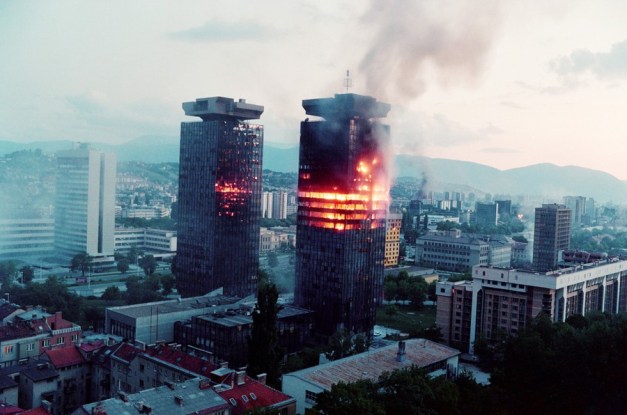
UNITIC’s twin towers, “Momo and Uzeir”, under attack in Sarajevo (Georges Gobet/Getty Images)
I don’t usually share my creative writing but I thought I’d share a short story of mine based on a famous, but possibly apocryphal, event from a journalist in the Bosnian War when I was experimenting with new assessment types for my War and the Media module.
A Literary Rite of Passage
‘Which one do you want to live?’ He cocked his gun, as if he was punctuating his question.
I froze. Everything froze. I could have counted the dust suspended in the air. We had been talking all night but now I could not think of anything to say. I just looked down at him incredulously.
‘Well? I’ve got two civilians in my sights. Which one do you want to live?’
I looked at my notebook, the edges creasing around my grip. For two days, I had been chasing a story about life in a besieged city. I shared food, stories and jokes with him, but I could not share this.
‘I’m a reporter’, I blurted, as if that justified anything. ‘I can’t…’
A smile seemed to curl around the side of his face. ‘Which one, Jack?’
When I was young, I remember sitting on the living room floor during a stormy Saturday night. My parents never let me stay up late, but that night was different. My father was on his second glass of whiskey and he never had a second glass. My mother was on the sofa, crying into her handkerchief between puffs of her ceaseless cigarettes. Most of my childhood memories are behind a veneer of cigarette smoke, but the smoke was particularly dense that evening. It was November 1963. The storm outside seemed to cover the whole world.
David Frost was on television. It was the only time I remember him looking young. His crisp, clear accent was ageless though. Normally on a Saturday, I would be under the covers in my bedroom trying to drown out the sound of my father’s laughter as I read. But no one was laughing tonight as Frost told us in a sombre tone about how the death of Jack Kennedy left the world feeling empty. I was too young to have heard the name Jack Kennedy or JFK before that night, but I knew from Frost’s tone that the nation’s grief was my own, even though I did not understand why. What I did know from that night onwards was that I wanted to speak truth from the heart, translate the unspeakable into words: I wanted to be a journalist. I dreamt about being the first journalist to break an important story. Corruption in Parliament? Bribery at the Olympics? Whatever the story, one day I would see my name on the front page: ‘Jack Lansdale, Journalist’.
After finishing my degree four years ago, I began working for the Daily Chronicle. Although the editor, Jimmy, had been impressed by my dissertation on “War Reporting as a Literary Rite of Passage in the Spanish Civil War” the only job available was covering local sports. It was a placeholder, he claimed, until a ‘real job’ became available. I had not realised what exactly he meant by a real job until I was told last week that I was being sent to cover the Bosnian War. I was being given my own ‘Literary Rite of Passage’, he said. Excitement flooded over me. It drowned my senses as I imagined myself as Hemingway, Gellhorn or Orwell. Real reporters, gallantly championing the cause of truth and justice from the middle of a war.
Passage to Sarajevo had been secured on a United Nations flight. Sarajevo was the capital city of newly independent Bosnia and Herzegovina. Although it was currently besieged by the Bosnian Serb Army, the UN had control of the city’s airport. During the flight, I tried to catch up on the history of the Balkans, but the situation was confusing. Yugoslavia had broken down into different nationalist and racial factions: Bosnian Serbs, Bosnian Muslims, Bosniaks, Croats, Bosniak-Croats. Each group seemed to have their own prejudices and there seemed to be tension on all sides, some historic and some new. The whole situation was an indecipherable mess, but it was my chance to translate the untranslatable to people back home.
My editor and I agreed I would initially go to Sarajevo for just a few weeks so I travelled light. A change of clothes in my duffel bag and my well-worn copy of Orwell’s Homage to Catalonia in my pocket. From the airport, I hitched a ride in the BBC’s armoured car. Almost every journalist stayed in the Holiday Inn, a brown and yellow block in the middle of the city. A conspicuous target, but it was a safe zone – as safe as anywhere in a war.
The other journalists staying there welcomed us, introduced us to the staff at the hotel, and told us which locals would act as translators or fixers for a few coins or packs of cigarettes. The war was all over the city; we should use the locals and wait for the war to come to us, the more experienced journalists told us. ‘Don’t risk your life for column inches,’ an older journalist warned us in the bar that evening.
Maybe it was hubris, arrogance or just overexcitement but I hated the thought of waiting. A Pulitzer Prize-worthy story was out there and after four years stuck in locker rooms and stadiums reporting fluff pieces for the Chronicle’s sports page, I was going to find it.
‘I’m not waiting around! Gellhorn. Hemingway. Orwell. They all chased the story.’ I help up my copy of Homage to Catalonia. ‘Orwell didn’t wait for the war to come to him. He chased it. He fought for it. I’ll never be a real war reporter if I just wait.’
‘That’s a sure-fire way to get killed.’ Amanda Seaton, the young Irish reporter next to me waved her hand in front of her face to waft away the cigarette smoke. ‘I grew up on the border, I grew up in a warzone. There’s always a story to tell, but bullet-chasing journalists end up getting chased themselves.’ Her dark uncombed hair betrayed the time she’d spent in Sarajevo. The hotel was safe, but there was no hot water.
‘Not all of them,’ I snapped back. I was not going to let a twenty-year-old reporter tell me how to work.
Her expression grew stern. ‘Not the lucky ones.’
By midnight most of the group had disbanded. I was the last in the bar to settle my tab with the waiter, a young man who grew up in Sarajevo. He told me he had overheard my speech. He wished other reporters would go looking for stories.
‘Every reporter focuses on civilians. But before war many of us were friends with soldiers who now shoot us.’ His near perfect English was impressive.
‘You think I should interview the soldiers?’
‘Yes, but not our soldiers. The Bosnian Serbs. If you want to help, you need to understand all sides. To understand our side, you need to understand theirs.’
‘How? I can’t just walk up. I’ll be shot before I can ask.’
He lowered his voice to below a whisper. ‘I have friend. Old brother-in-law, who is a sergeant in the Bosnian Serb Army. We still talk. Secretly. I can arrange meeting, if you keep it between us.’
The young waiter must have seen the concern on my face. ‘You will be safe with him.’
‘Thank you.’ I took a few notes out of my wallet to hand to him.
‘No’. He pushed the money away. ‘I only want to help people to understand. I don’t want to get rich from war’.
I had to give him something, I told him. I could see that he was eyeing up my copy of Homage to Catalonia, but he was too polite to ask. The hardest thing about the siege, he told me, was the lack of books. Most of them had been burnt in the winter, and he had read the rest. I handed it over, but only after he promised to make sure it was the last book he would burn. We agreed to meet in the laundry room at 5am.
By 5.30 am, I was wedged between two white laundry bags in the back of a green Skoda. I tried to ignore the three cylinders of light coming through the passenger side of the car, just above a red stain. The car had seen better days, but it ran smoothly.
Where we were heading was near the hotel, but it was a long drive. The city’s main boulevard, ‘Sniper Alley’ as it was now called, was too dangerous to drive down. The city seemed grey, empty and yet strangely haunted by life. In the backstreets, burnt-out cars became playgrounds for children dressed in colours that the city itself seemed devoid of. Eventually, we arrived at a dilapidated apartment block. Mortars had burnt most of it down but in dawn’s light it looked almost peaceful, like a hermit crab’s shell abandoned to nature.
The waiter told me that his brother-in-law, Kazimir, was waiting on the 14th floor, in the apartment overlooking the Hotel Inn.
Each step on the staircase felt less certain. I hugged the wall as closely as I could. The building was abandoned for good reason. I could feel my adrenaline rise. I was excited to tell the story of Kazimir and his star-crossed family, to see my name printed on the front page: ‘From Our Correspondent in Sarajevo’.
My enthusiasm made me forget the danger and I soon found myself knocking on the apartment door. Kazimir let me in. His posture and well-toned physique suggested that he was a professional soldier, rather than a paramilitary. His hair was mostly grey, but it had a strong memory of being blonde.
‘Welcome, Mr Lansdale.’ His smile emanated genuine warmth.
‘Jack, please.’ I sat in the chair he pulled out for me as he poured a cup of viscous black coffee.
He asked me about the story I was writing and how he could help. I told him I just wanted to observe, listen, and learn about his life before the war and why he was fighting. He nodded.
At first, we spoke about his hometown, a village called Skelani to the east of the city. Before the war he had been a music teacher at the school, which was how he had met his wife. They were married for five years before she got pregnant.
If only I had been less focused on the story, less focused on how to turn quotes into headlines, maybe I would not have dismissed his use of past tense as bad grammar. If only I had known the situation better. If only I had not asked him about his old life, but I kept pushing. I asked him why he was a sniper, why the army did not simply occupy the city.
‘Sarajevo is a wound that we can bleed,’ he said. ‘Every day we bleed the city for every drop they bled from us. We are all owed some. I am owed some.’
What a great headline, I thought. ‘What about those in the city? The innocent people who do not choose to be here?’
‘We all have choice. The idea that anyone in war is innocent is wrong, Jack. The first casualty of war is not truth but innocence.’
The rest of that night was quiet. We talked about the war, but also music, literature and history. We could hear gunfire and explosions from the other side of the city, and it was easy to talk about war when nothing happened near us. Until morning.
‘Which one, Jack?’ Kazimir spoke coldly. Everything about him was cold now.
‘No, I can’t…’ He was looking away from me, down onto the street below us, yet I could feel his gaze on me.
‘I’m giving you a chance to save someone’s life. A chance they never gave my family.’
I started to walk away towards the door. With each step my heart raced. The dust rose and the wood creaked under my feet, then two short, loud pops.
‘That’s a shame.’ He did not even look up. ‘You could have saved one’.
Amanda found me walking down Sniper Alley. She taught me some techniques to get over the shock and talked me through what happened. She encouraged me to write the story, if only to help me process things. This time I listened to her. I locked myself away learning what I should have learnt before I came to Sarajevo. I read about the escalating tensions, about the massacre of women and children in Skelani. I wrote about a tolerant city infected with hate, star-crossed families caught in a cyclone of violence and neighbours becoming enemies. I warned my readers how close we all are to descending into chaos. It was the best thing I have ever written but it would never be worth what it had cost. I wired it to Jimmy with a note to say that I was coming home.
I got Jimmy’s response almost immediately. He congratulated me on my “rite of passage” but he had to put my article on page nine. There was a more pressing front-page story: “Bill Clinton’s Hair Holds Up LAX: The Most Expensive Haircut in History?’
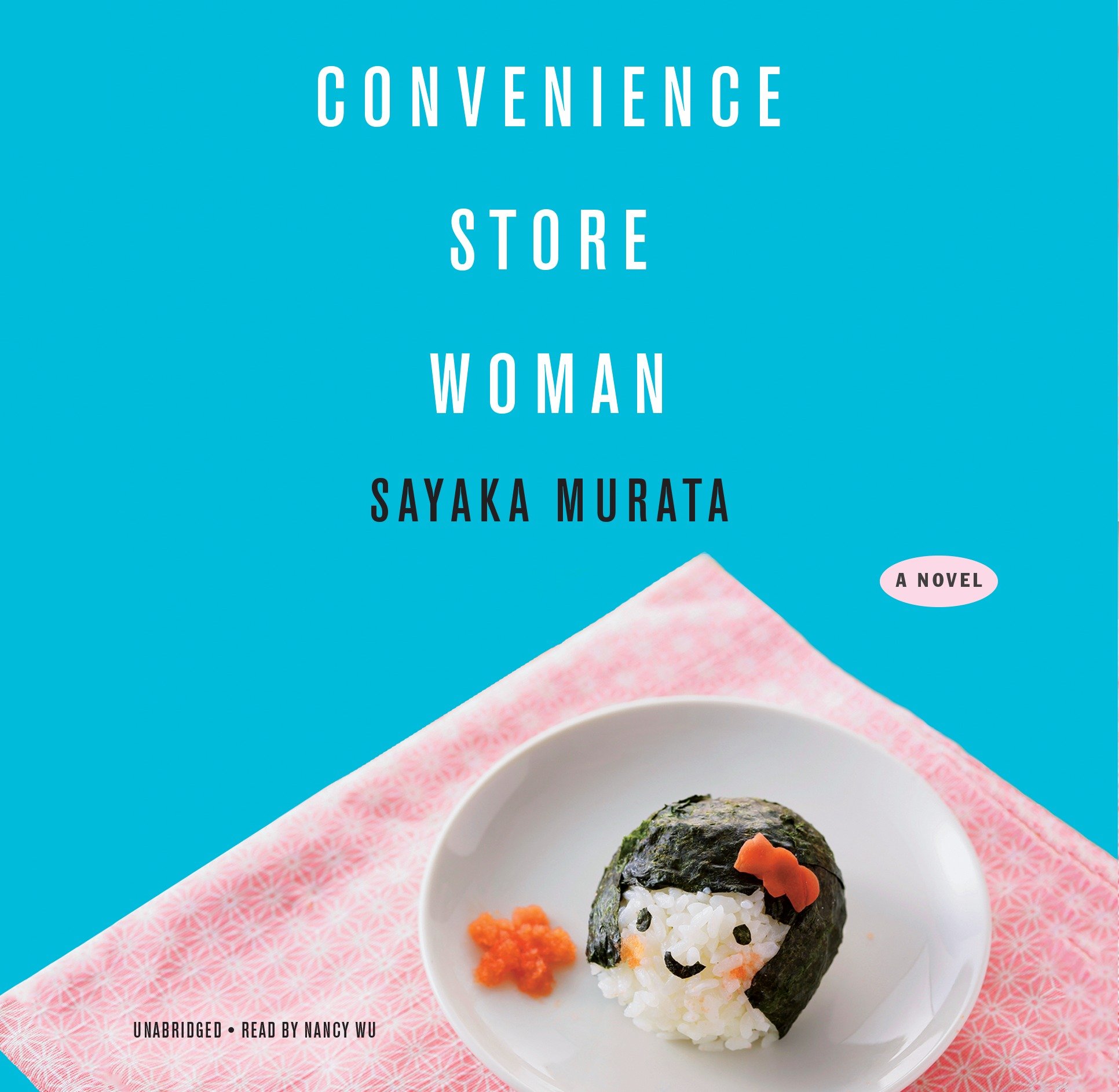
It’s been a while since I’ve done a book review. I finished this back in January but the start of the semester and the end of society distracted me from writing up a review.
Convenience Store Woman is about exactly that. It about the experience of Keiko Furukura a woman in her mid-thirties who has worked for a convenience shop all of her adult life. Keiko finds comfort in the routine the store provides her. Every social interaction is considered and controlled. There’s a clear structure to her day thanks to the shift system. She doesn’t have to worry about what to wear thanks to the uniform.
Outside of life, she finds everything a lot harder. Social interactions are unpredictable. People have expectations that Keiko doesn’t understand and they don’t understand why she is both single and happy working in a convenience store for the rest of her life. She gets increasingly irritated that people don’t understand that her life doesn’t conform to societal norms. When she meets Shiraha, a rather deadbeat misogynist, she sees an opportunity to placate her family and friends by quitting her job and pretending to settle down. However, she finds it very difficult to adjust to her newfound freedom.
The author never tells the reader why Keiko is different. As a reader you get a clear sense that Keiko is different but it feels natural thanks to the way Murata portrays her thoughts and interactions. You never feel sorry for her or pity. In fact, I felt there was a comfort in the way she viewed the world. A safety to it. In some ways, I thought Keiko’s portrayal was a very accurate portrayal of ASD in places, whether that was intentional or not.
Convenience Store Woman is Murata’s first novel to be translated from Japanese. Earthlings is due to be released later this year and I look forward to reading more of her work. I haven’t read the work of many Japanese authors but Murata and Murakami have certainly encouraged me to explore more.
Diary Entry: 14 April 2020.
It’s very hard to pinpoint how long we have been in lockdown; sometimes it feels like a few days, sometimes it feels like months.
I have only left the house three times in the last four weeks.
First, to walk the dog. I didn’t realise how badly I missed the sea until I saw it and felt a contradictory excited peacefulness. It was hard to avoid people. It was only the first week, and it didn’t seem many were taking it too seriously. One man laughed at me when I asked if he could keep a little more distance.
Second, for a run. I have been jogging on the spot, doing HIIT training via YouTube tutorials, and doing more exercise than I ever have before in my living room, but I needed to be outside. I felt guilty being out, and more anxious the further I got from my front door. It was a short run.
Third, to walk the dog at midnight. Much calmer, much quieter. Much more surreal and sobering.
Working from home is far more difficult than I thought it would be. The demand for our services as a mental health charity is far greater now, and I can feel a pressure to perform above and beyond our usual support service. The job demands a level of attention to other people and their problems that is far easier when I am alone in a room with them. Almost impossible to master at home on the sofa surrounded by books, games consoles, and a puppy.
It’s a weird limbo. Like there’s half of me rushing through it, barely aware of what’s happening, the other half slowed to a stop in a state of constant anxiety. I suppose that’s why it’s hard to feel any consistency of time. Everything has changed.
I think I first learned about it from online news. thought it was all a storm in a tea-cup. “Afterall, there have been”, I reasoned, ” loads of pandemics even in my lifetime. How many have amounted to anything?” I was aware, of course, of the 1918-19 Influenza pandemic, the Black Death, the destruction wrought by Eurasian disease in the Americas after 1492. But, in our day and age, in 2020, that surely could not happen again. It was a preposterous proposition.
Rather than tell my specific COVID-19 story, as in what I was thinking, I want to record what I was thinking *and* what I now know.
Over the course of February, I remained largely unimpressed by the threat posed by this virus. I later learned that it had first reached the shores of Britain as early as late January. It had claimed its first life, a tourist from China soon after. Writing now, in mid-April, and this is an important point to keep in mind, I didn’t see about any of this. I was busy with my job, Brexit was still all over the news cycle and we had a new government. Moreover, the US Senate trial of Trump was also all over the news. This new virus was covered in a few seconds in the news cycle, as a minor natural disaster largely centred in China. A tragedy, but “one of those things”.
During this period the day-time television celebrity, Philip Schofield had come out as being gay on 7 February. This, for reasons which this writer cannot discern, was a topic of vast public concern. What was happening in Wuhan was rendered peripheral. At least 722 people in China died that day from COVID-19.
As February dragged on and March began, things had clearly begun to change. The reporting seemed more ominous. During this time, reporting from China became more and more extreme. The number of those infected by this new disease, which appeared to have neither vaccine nor cure, was ravaging Wuhan the capital of Hubei Province, where this virus had started life. Within a week, the number of deaths in China had increased from 722 to 1,523. In addition, the number of known reported cases had increased from 35 thousand to 65 thousand. There were lots of news reports about the crisis. I learned then that there was such a thing as a ‘Public Health Emergency of International Concern’ which the World Health Organisation had, apparently, called at the end of the previous month.
But, here in the West, things still looked under control. Donald J. Trump, the President of the United States informed Americans, and by extension the world, on 19 February that “when we get into April, in the warmer weather—that has a very negative effect on that, and that type of a virus.” Later, that month, he claimed, on the 27th, “It’s going to disappear. One day it’s like a miracle—it will disappear.”
Clearly then, Donald Trump had gone, from ignoring the issue almost entirely, to playing it down to suggesting it had been defeated. It was, initially, in his view, a minor issue which would be over in a matter of week if not days. This view did not last long, but it did remain intact for weeks, which proved crucial. Similarly, our new Prime Minister, Boris Johnson, hadn’t really engaged with the issue. This is also crucial.
Much later than today, I learned that the first Coronavirus episode in the UK was the arrival of a tourist from China on 31 January. Throughout the remainder of February, life remained more or less the same, though news reports became increasingly grim from China. A key recollection was when things began to get bad in Spain and Italy. By 25 February Spain had only nine recorded infections, within a week they had 165, within another week 1,695, by 15 March some 7,988 infections.
Throughout March, things became particularly bad. My previously irreverent attitude had given way to the obvious reality. This was not “like another flue” as Donald Trump had claimed. By 15 March COVID-19 had claimed the lives of 69. By the time of writing, on 14 April, it has claimed 23,640. In one month. The UK is no different, 35 to 11,329 deaths in one month.
By the end of February, China had gone into complete lockdown, which dominated the news. Wuhan, where the virus began, seemed to be being clamped down upon with particular force. Where before, reporting from that part of the world had shown civilians in masks, it was now of soldiers in camouflage spraying empty streets spraying down the pavements and roads. At around the same time, or at least shortly after, worrying news began to emerge from Continental Europe. Italy, Spain and France, were all soon bogged down. It was soon a case, as life went on, entirely as normal in the UK, that Italy and Spain had vast problems.
By mid-late February the first lockdown in Italy had begun, which were met by considerable press reportage in the UK. By 8 March, norther Italy as locked down and by 16 March the entire country was in isolation. Over the week prior, in the UK we had seen young medical professionals, worked to the bone, up day and night, pleading with us for resources and with dire warnings regarding what was coming. It was one of the most shocking sights of my life: an advanced economy brought to its very knees in a matter of a couple of weeks. I confess, only then did I really grasp that this was as serious as it is (at time of writing). We learned that Personal Protective Equipment (PPE) was in short supply, as were ventilators, but most importantly, medical staff. Also, that, this disease kills medical staff in huge numbers. That they need PPE.
From the UK, this seemed both incredible and shocking. ‘Still’, I thought, ‘we will be OK’. The government has control of this. This happy view was soon shattered. By early March websites had begun to appear which collated and graphed the number of infected and those who had passed away as a result of the virus. From a UK position, they did not look good. By 20 March the UK had already endured 177 deaths. This was a full month after the first case of COVID-19 had been transmitted on UK soil. Within weeks, on 12 April, that tally had reached 10,612. This will rise. Significantly.
The UK went into lockdown on 23 March.
Thought I would do this more regularly .. ho, hum. Another target, another whoosh.
13/04/2020.
It is now 2 weeks since I have left home (albeit briefly for supplies) … so once in 4+ weeks. No intention of doing any more than post a birthday card down the lane this week; but may need to venture out in 2 or so weeks.
This IS the new normal. I’m now vacillating between happiness and guilt: I am loving the freedom of doing little, doing it well, gardening, cooking, enjoying the sun, the wind, the growth; but feeling guilty that I am lucky to have a great place to be, space, garden, some savings and another person to isolate both with and from. Also, have routed through my boxes of kit from previous forensic expertise and found a few masks, gloves and goggles. So can gear up to go out, to protect my high risk, older, vulnerable partner-in-isolation.
Thought I’d ask my grandkids their views on a couple of questions – through the medium of zoom, and then transcribed. So, we have L (Catford, male, 7) and P (Catford, male, 6).
Mamgu: Now you’ve been away from school for 2 weeks, what’s the best thing about it? And what’s the worst thing?
L: Best thing is not having to do school work all day, every day. Worst is that I can’t see my friends.
P: Best is playing in the garden and going to the park every day. Worst: not seeing my friends.
Mamgu: Why are you home from school at the moment? Do you know the reason?
L and P both answered “Corona-virus” and “we aren’t supposed to be near other people in case they get ill or we get ill.”
Mamgu: What’s your favourite thing that happened recently?
L: We had water fights in the garden with my brother and over the fence to neighbours.
P: Cycling my bike around the circuit at the nearby park. There are distance markers and I did ride 5 kilometres.
We zoom a little and I am sending them maths puzzles everyday – little short fun exercises … knowing most other stuff will be well covered at home. They seem fine. But I guess we’ll only know the impact in a few years for all the kids who have missed school, the many who aren’t turning up even though they are on the list for safeguarding, those who missed GCSEs, AS and A levels, final exams at Uni and more. Talking of which, I need to really get on with that OU course, time is fast running out.
April 12th 2020
I’ve been in my flat for a month now. We started working from home a week before the official lockdown, so my daily walk to and from work feels like forever ago. I was supposed to be visiting my parents this weekend. I don’t actually remember an Easter weekend I haven’t spent on my own for one reason or another, but not being able to escape my flat and get outside properly has made this particular weekend difficult.
I spent most of yesterday reevaluating my life choices. Totally healthy, I know. I live alone, in a flat without a garden, and no pets. The closest I can get to being outside (aside from the rare occasions where I venture out for a walk) is sitting on my windowsill. I find it really hard not to look at the families and couples walking down the street below without feeling bitter resentment. Did I make the right choices? Should I have “settled down”, not been so worried about a career? I’ve always been an independent person, but this whole situation has me wishing I had people, a family. Something.
I’ve been trying really hard to focus on the present – I’m lucky enough to still be working full-time, and it’s challenging, but it fills the days. But not being able to think clearly about the future is making my normal everyday worries worse.
I haven’t seen my boyfriend in a month. Our situation is complicated anyway, but I’m finding it hard not to worry that this indefinite period apart will change things too much. I’ve never felt further away from him.
I feel like when this is over I want to make things different. I don’t want to be alone. I don’t want to be stuck in the top floor of a building. But then… how much of that is in my control anyway?
At least I could get a cat.


 Dr Kristopher Lovell